Efficore
Co-founder & Software Engineering Lead
AI-powered energy optimization platform for data centers and solar-backed homes, reducing cost, carbon footprint, and risk by coordinating grid, on-site generation, storage, and cooling.
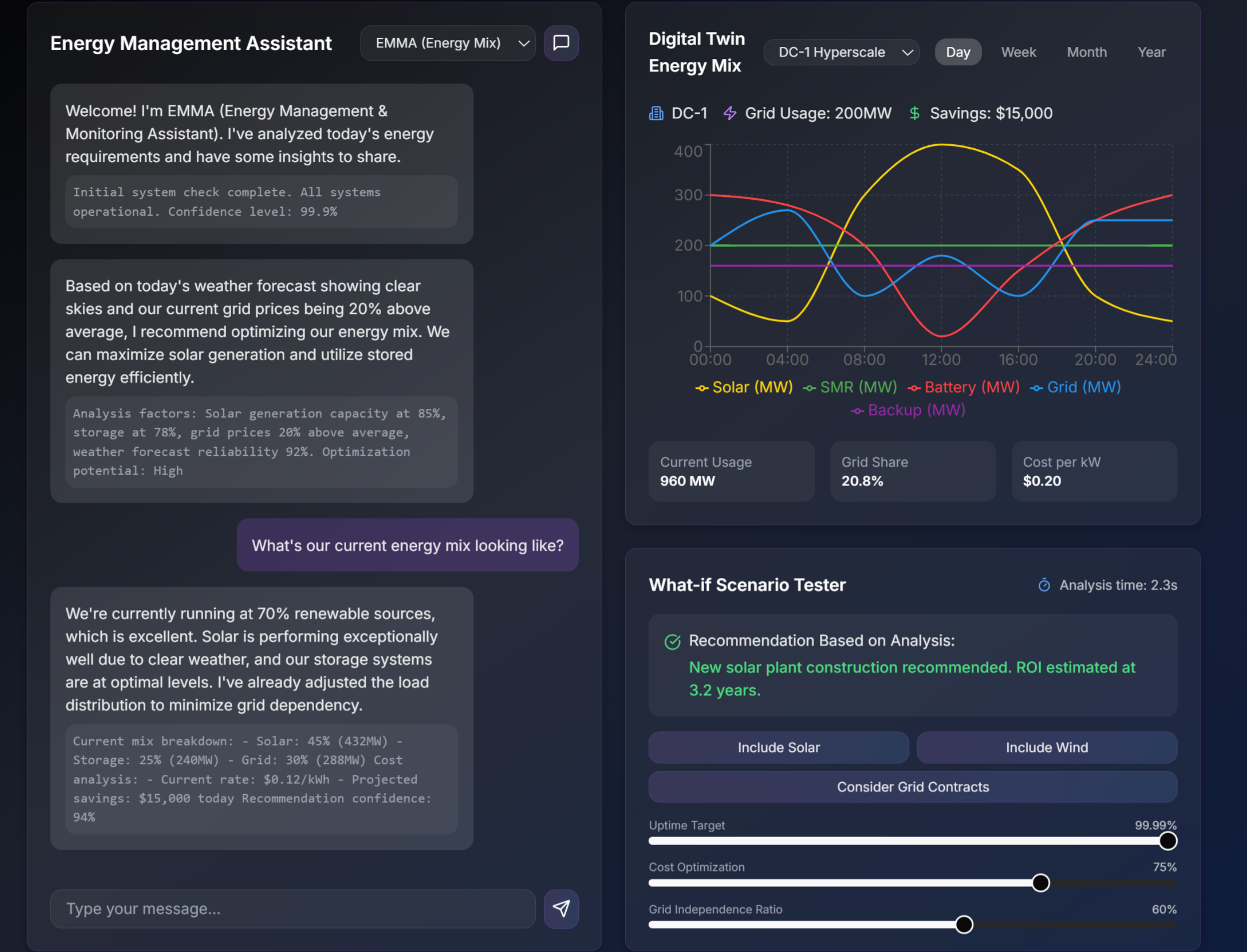
Efficore is built around a simple but aggressive idea: stop treating grid power, generators, batteries, solar panels, and cooling as separate silos. Instead, optimize the whole system as one controllable unit.
The Problem
For Data Centers: Energy is often the largest operational expense, and reliability is non-negotiable. Carbon emissions are becoming both a regulatory and reputational issue. But today, operators manage grid power, diesel generators, UPS batteries, and cooling in isolation, with mostly manual coordination. The outcome: suboptimal decisions, wasted energy, higher bills, and unnecessary carbon emissions.
For Homes with Solar + Batteries: Residential systems face similar challenges on a smaller scale. When should you charge your battery from solar vs. grid? When should you sell power back to the grid? How do you balance cost savings with maintaining backup power for outages?
In both cases, there’s no unified brain — just a patchwork of controllers and human guesswork.
How Efficore Works
Unified System View – Efficore treats your entire energy infrastructure — grid connection, on-site generators, solar panels, battery storage, HVAC/cooling — as a single coordinated system rather than isolated components.
Digital Twin + AI Optimization – We build a high-fidelity digital twin of the facility that models:
- Energy demand patterns (by time of day, season, workload).
- Grid pricing (time-of-use rates, demand charges, peak pricing windows).
- Weather forecasts (affecting solar output and cooling load).
- Equipment constraints and efficiency curves (battery health, generator fuel use, HVAC capacity).
- Carbon intensity of power sources (grid vs. on-site).
With this simulation environment, an AI optimization layer can then recommend (or autonomously execute) decisions like:
- Grid vs. On-site Power – When to draw from the grid versus firing up on-site generators or discharging batteries.
- Battery Scheduling – When to charge batteries (e.g. during solar overproduction or off-peak grid hours) and when to discharge (peak hours or outages).
- Solar Utilization – When to use solar energy on-site, when to store it, and when to sell it back to the grid for revenue.
- Pre-cooling & Load Shifting – How to precool or adjust HVAC settings ahead of peak price periods, or shift non-critical loads to cheaper times.
- Emergency Reserve – Ensuring there’s always enough battery or generator capacity kept in reserve for reliability, while still optimizing cost.
“Emma” AI Interface – Rather than a black-box optimizer, we provide an AI assistant interface (Emma) where operators can ask natural language questions and get scenario analyses:
- “What happens to our costs if grid power reliability drops 20% next quarter?”
- “How much could we cut carbon emissions without increasing our energy bill?”
- “Show me the ROI if we add two more battery packs.”
Emma translates these queries into optimization runs or data queries on the digital twin, and returns answers with plain-language explanations and charts. This makes the advanced optimization understandable and trustable to operators.
What We Optimize
For Data Centers:
- Cost – Reduce energy spend via smarter use of grid vs. generators vs. battery (especially to minimize demand charges and peak rates).
- Reliability – Maintain uptime by intelligently managing backup power and cooling during grid constraints.
- Carbon – Lower emissions per unit of compute by dynamically using cleaner power (scheduling loads or charging storage when renewable content is high).
For Residential Solar + Battery Systems:
- Cost – Maximize use of free solar energy, minimize buying expensive grid power at peak times.
- Resilience – Ensure battery backup is available for critical loads during outages (especially as extreme weather events become common).
- Grid Services – Optionally, participate in demand response or feed-in programs to earn money or credits by supplying power when the grid needs it.
Technical Architecture
Multi-Agent Reinforcement Learning – At the core is a multi-agent RL engine where different agents represent different assets (the grid tie, the battery bank, the solar array, the cooling system, etc.). They coordinate to find an optimal strategy under changing conditions, learning to balance cost, reliability, and carbon goals.
Digital Twin Simulation – A physics-informed simulation environment (our digital twin) models power flows, thermal dynamics (for HVAC), storage efficiency, and grid interactions. This allows safe training and testing of strategies before deploying them.
Forecasting Models – We integrate time-series forecasts for key variables:
- Load forecasting for power demand (using historical data + upcoming known workloads or weather).
- Solar generation forecasting (from weather predictions).
- Energy price forecasting (if on variable tariffs or participating in energy markets).
- Equipment failure risk (so the optimizer can schedule maintenance or avoid overstressing aging components).
Optimization Solvers – We blend approaches: the RL agents handle real-time adjustment and learning, while traditional solvers (mixed-integer linear programming for example) handle day-ahead planning or one-off scenario optimizations. This hybrid approach yields both adaptable control and guaranteed optimal schedules for lookahead scenarios.
My Role
As the Software Engineering Lead and co-founder, I:
- Designed and implemented the multi-agent RL decision engine, translating real-world energy constraints into reward functions and agent observations.
- Built out the digital twin framework so that every pilot site (whether a data center or a smart home) can be configured and simulated with their specific equipment and tariffs.
- Developed the AI assistant interface (Emma) to make the complex optimization outputs accessible — effectively serving as the bridge between hard analytics and a human operator’s decisions.
- Work directly with early customers to integrate their live data feeds (power meters, battery controllers, HVAC sensors) and validate that Efficore’s suggestions actually work on-site.
Current Status
Efficore v1.0 Alpha is live for testing. We’re working with pilot customers from the NUvention Energy network and other early adopters to validate the platform in both data center and residential settings. Early results show potential for 15–25% cost reduction in data center energy spend and 20–30% improvement in solar self-consumption for homes — all while maintaining or improving reliability.
We are also actively exploring residential energy optimization as a key market (using the same core engine for solar-powered homes), and conducting research into data center grid interconnection policies and regulations to ensure our system’s strategies align with real-world constraints.
Why This Matters
Energy is the defining bottleneck for so many modern systems — from cloud data centers powering AI, to individual homes trying to go green. Efficore’s vision is to make these systems dramatically more efficient and resilient without requiring operators to become energy experts. It’s the software layer that turns “dumb” infrastructure into an intelligent, self-optimizing organism.
In a world racing toward AI and electrification, solutions like Efficore help ensure we don’t run into an energy wall. We can increase capacity, cut emissions, and improve reliability all at once by using smarter control.